

Friday, 05 June 2026
Textile products are used in a wide range of applications and are exposed to soil, biological staining and chemical contaminants. The objective of any commercial laundry operation is to achieve acceptable visual and bacteriological cleaning results, while minimising damage to the textile product.
澳大利亚标准、, AS 4146-2024 Laundry Practice, provides a means of evaluating the performance of chemical and machine-washing systems through the use of standard control fabrics. As textiles are susceptible to damage from factors such as chemicals, temperature, and mechanical agitation, improper laundering can significantly reduce their service life and increase replacement costs.
Strictly controlled comparative trials can be used to assess the performance of different washing machines or chemical systems, either within a single laundry or across multiple sites. The methodology is also suitable for laundries that must demonstrate compliance with prescribed contractual standards.
The testing process evaluates both the cleaning effectiveness of the laundering system and the level of textile degradation resulting from repeated washing. To ensure valid and reliable results, laundry and laboratory personnel must adhere closely to the prescribed procedures, as deviations may invalidate the assessment.
Standard control fabrics are supplied by AWTA Product Testing.
Cleaning Performance Assessment
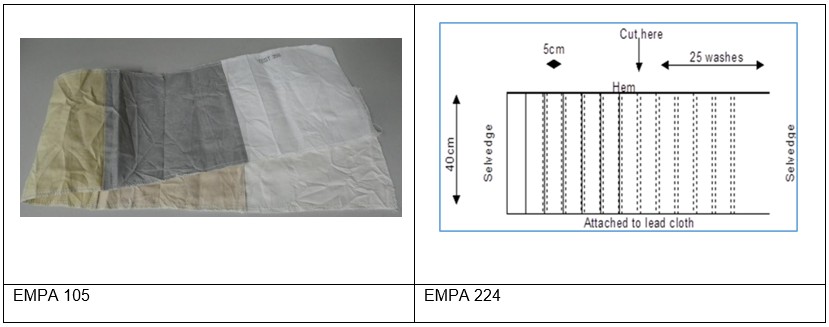
EMPA Style #105 control fabrics are washed with a single, normally soiled load using the laundering system under evaluation, or the process typically employed in day-to-day operations. Following laundering, the control fabrics are returned to AWTA for assessment of stain removal performance.
A spectrophotometer is used to measure:
- Whiteness
- Intrinsic greying
- Intrinsic yellowing
- Percentage soil removal from each of the four standard stains on the test fabric
The effectiveness of the laundering process is then assessed against the performance indicators specified in AS 4146-2024.
Fabric Damage Assessment
EMPA Style #224 control fabrics are washed through multiple normally soiled loads using the laundering system under evaluation. After either 25 or 50 laundering cycles, the fabrics are returned to AWTA for tensile strength testing.
The tensile strength of the laundered sample is compared with that of an unwashed control sample, and the percentage loss of fabric strength is reported. This provides an indication of the level of textile degradation caused by the laundering process.
Link to more information: https://n9.cl/w89w2
联系我们:
If you have any further questions on laundry testing, please do not hesitate to contact us for more details or a quote on:
电话:03 9371 2400 或发送电子邮件: [email protected]