

2025 年 11 月 10 日,星期一
We walk you through why Shade Structures are important, managing their performance and a go over BAL rating in bush fire prone areas.
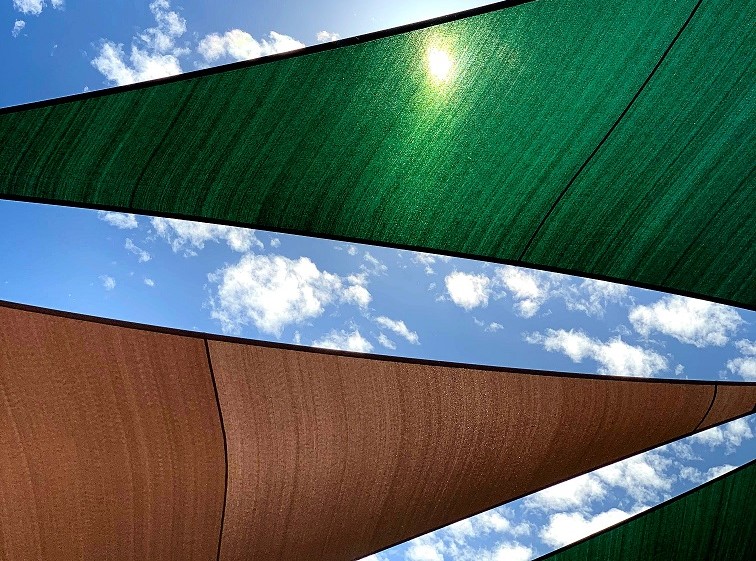
Spring time reminds us that it is time once again to give some thought to protecting our homes and property from the harsh Australian summer. We are fortunate to have some very good standards and test methods that help us to specify and manage product that helps get us through the hotter weather. Schools, homes, businesses, car yards etc. make use of popular textile shade structures to protect property and provide protection from harmful ultra-violet light.
Shade Coverings
紡織遮陽布結構通常是由經編聚乙烯紡織品製成。由於紗線和經編結構的特性,以聚乙烯為基礎的簾布結構具有非常好的防霉、防化學破壞、防雨甚至防風的能力。再加上精密的安裝方法,使其成為物理上非常穩定的系統。.
Shade structures can even, in very hot conditions, help to mitigate against another summer problem that we have in Australia – Bush Fires.
We do need to ensure however, that polyethylene textiles have adequate UV stabilisation. Resistance to UV degradation can differ somewhat depending upon colour and a UV stabiliser may be needed to assist some shades. To help us manage this risk and measure the performance of textile shade structures, assess their ability to survive a life cycle in Australian conditions, AS 4174:2018, Knitted and woven shade fabrics, is a standard that gives strong and tested guidance. This standard gives a simple accelerated weathering test method for predicting likely strength loss over time. This involves measuring initial textile strength followed up with a measurement after a 2000hr artificial daylight exposure.
Importantly, for horticultural purposes, the cover factor or measure of the UV radiation that is transmitted through the textile, is used to categorise shade cloths according to their cover factor range from ultra-light through to ultra-heavy cover. Physical tests such as burst resistance are used to determine resistance to puncture and tensile and elongation testing is done to ensure that the textile is suitable to maintain its shape and integrity under tension. Warp knit shade fabrics, when required to be assessed for flammability performance are typically assessed in accordance with AS 1530.2 to derive a flammability index and/or ASNZS 1530.3 for ignitability, spread of flame, heat and smoke measurement.
灌木林火災
As the heat builds up, it is a good time to have a look at our popular construction materials such as timber for decking and more and see how they shape up against AS 3959, Construction of buildings in bush fire prone areas. This standard specifies construction and materials requirements for buildings in our regions prone to bush fire attack.
我們提供了叢林火焰攻擊等級 (BAL) 來幫助進行條件分類,並了解產品對燃燒余燼甚至直接火焰接觸的耐受性。.
AWTA Product Testing offers the cone calorimetry testing in accordance with ASNZS 3837 for BAL rating timbers up to BAL 29. Average heat and peak heat release rates when exposed to a specific heat irradiance allow for an objective means to assess timber for suitability for use at the various bush fire attack levels. Sarkings, roof flashings and door seals are tested to AS 1530.2 to derive the flammability index levels specified.
聯絡我們:
If you have any further questions on shade cloth or bush fire BAL rating, please do not hesitate to contact us for more details or a quote on:
電話:03 9371 2400 或電子郵件: [email protected]